
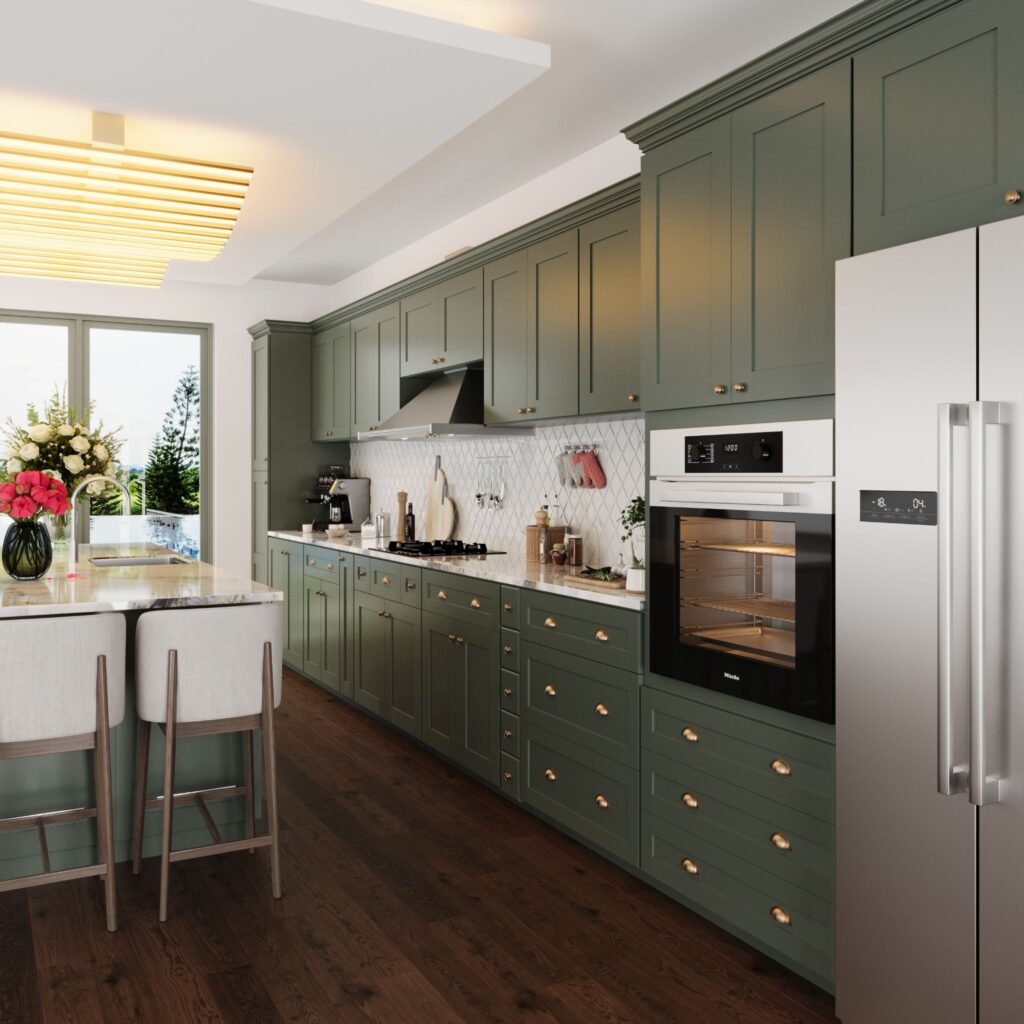
Buying RTA cabinets that ship flat and are assembled on site, starts long before you pick a finish. Maybe the doors no longer close square, maybe the finish is dated, maybe a quote from a custom showroom made you sit down for a minute. Somewhere in the research you hit the term RTA, and the price difference was big enough to make you both curious and a little skeptical.
This is the full process, in order, from that first decision to the morning you load dishes into cabinets you assembled yourself. Walk through it step by step and almost all of the uncertainty disappears. The short version: measure carefully, judge the construction rather than the photo, inspect the delivery the day it lands, and the assembly everyone worries about turns out to be the easy part.
Step 1: How to Measure Your Kitchen for Cabinets
The most common first mistake is browsing door styles before touching a tape measure. Measure first. Working through a room-by-room measuring sequence keeps you from missing anything: sketch the kitchen, record every wall length, note the ceiling height, and mark the windows, range, sink, and refrigerator with their distances from each corner. Write down where the plumbing and gas lines enter, because relocating them is the single change most likely to turn an affordable remodel into an expensive one.
These numbers are what you order against. Cabinets come in standard widths, typically in 3-inch increments, and your measurements tell you which sizes fill your walls with the fewest awkward gaps. Where a gap is unavoidable, a filler strip closes it cleanly. Get this stage wrong and nothing downstream fits, so it is worth measuring twice, on two different days, before you trust the numbers.
Step 2: RTA vs. Stock vs. Custom Cabinets, What’s the Difference?
Before picking a line, it helps to understand the three ways cabinets are sold, because the price gaps between them are large.
Custom cabinetry is built to order in any size and finish, and priced accordingly, often $500 to $1,200 per linear foot installed, with weeks of lead time. Stock and semi-custom sits in the middle: fixed sizes, sold pre-assembled, quicker to get. RTA uses the same standard sizing as stock but ships flat for on-site assembly.
That flat-pack model is the entire reason RTA costs less, and the size of the savings depends on what you compare it to. Against comparable pre-assembled stock cabinets, expect to save roughly up to 50 percent; against custom cabinetry. Crucially, those savings come from compact shipping and skipped factory-assembly labor, not from cheaper materials. The savings are real, but quality is not automatic, which is exactly why the next step matters most.
Step 3: How to Tell If RTA Cabinets Are Good Quality
A cabinet looks finished in a photo whether it is built to last twenty years or two. The difference hides in details the image will not show, so this is the stage to slow down and read the spec sheet. Four things decide durability.
The box. Look for a plywood box rather than particleboard or MDF. Plywood holds screws securely and resists the moisture that lives under every sink, while particleboard can swell and lose its grip on fasteners when it gets wet. The independent ANSI/KCMA A161.1 cabinet standard tests exactly this kind of structural and moisture performance, which is why a certified box is a useful quality signal. More plies generally means a stronger panel, with quality plywood running seven to nine plies.
The face frame. Solid wood, the part your hands touch a thousand times a month, holds up far better than a veneered substrate that wears at the edges.
The hardware. Soft-close hinges and full-extension glides should be included, not billed as an upgrade. When they cost extra, the savings usually came from somewhere you cannot see.
The finish. A baked or catalyzed finish cures hard and resists the edge-chipping that makes a kitchen look tired early. A finish named only by color may be air-dried and softer.
If you would rather control the color yourself, an unfinished shaker line gives you the same plywood box and dovetail drawer construction but ships ready to prime and paint, which is also how two-tone kitchens get done without paying for two factory finishes.
Step 4: Ordering RTA Cabinets and Checking Your Delivery
Once sizes and finish are settled, you order against your measurements and a freight delivery arrives, often within a week or two, in flat cartons stacked on a pallet. Open and inventory everything the day it lands. Count the boxes against the packing list, check for shipping damage, and confirm the hardware bags are inside each carton. Sorting a missing part or a damaged panel on day one is far easier than discovering it halfway through assembly on a Saturday night, when a back-ordered piece can stall the whole project.
Step 5: How to Assemble RTA Cabinets (Tools and Time)
A single base or wall cabinet goes together in 15 to 45 minutes depending on experience. Most lines use cam-locks, dowels, or screws, with labeled parts and printed instructions in the box. The tool list is short: a drill or screwdriver, a rubber mallet, and a square to confirm the box is true before you lock it down.
Two mistakes cause most of the trouble. The first is over-tightening, which can crack a panel, so fasteners should be snug, not forced. The second is fastening before checking square, which leaves doors hanging crooked across the run. Check square on every box and you have sidestepped the only problems worth worrying about. A full kitchen’s worth typically comes together over a weekend, or in a day if you hand it to an installer.
Step 6: Installing RTA Cabinets the Right Way
With the boxes assembled, installation follows the same rules as any cabinet: locate the studs, work to a level line drawn from the floor’s high point, shim for the floor’s unevenness, and anchor into solid framing rather than drywall. Then comes the quiet payoff, adjusting the hinges so every door sits even. Modern hinges adjust in three directions with a screwdriver, and that ten-minute pass is what makes the whole kitchen look professionally installed.
Frequently asked questions
Is “ready-to-assemble” the same as flimsy? No. Assembly and quality are unrelated. A flat-packed cabinet with a plywood box, solid-wood frame, and dovetail drawers outlasts a pre-assembled particleboard one. Judge the spec sheet, not the format. Well-built RTA cabinets commonly last 20 to 30 years.
How much do RTA cabinets actually save? It depends on the comparison: roughly 30 to 50 percent versus comparable pre-assembled stock cabinets, and up to 50 to 75 percent versus custom cabinetry on the cabinets alone. The savings come from shipping and labor efficiencies, not reduced materials.
What if I order the wrong size? This is why careful measurement comes first. Order against standard cabinet widths (usually 3-inch increments), and where a gap remains, a filler strip closes it cleanly.
How long does the whole process take? Delivery is often a week or two, assembly a weekend, installation another day or two. Many first-timers go from order to cooking in under a month, faster than custom cabinetry’s lead time alone.
What’s the one step not to skip? Inventorying the delivery the day it arrives. Catching a missing part or shipping damage on day one keeps a small issue from stalling assembly later.
Buying cabinets this way rewards the person who measures twice, reads the construction specs instead of the photo, and counts the boxes on delivery day. Handle those three things and the much-feared assembly step becomes the most satisfying part of the project, the afternoon a stack of flat boxes turns into a kitchen.