
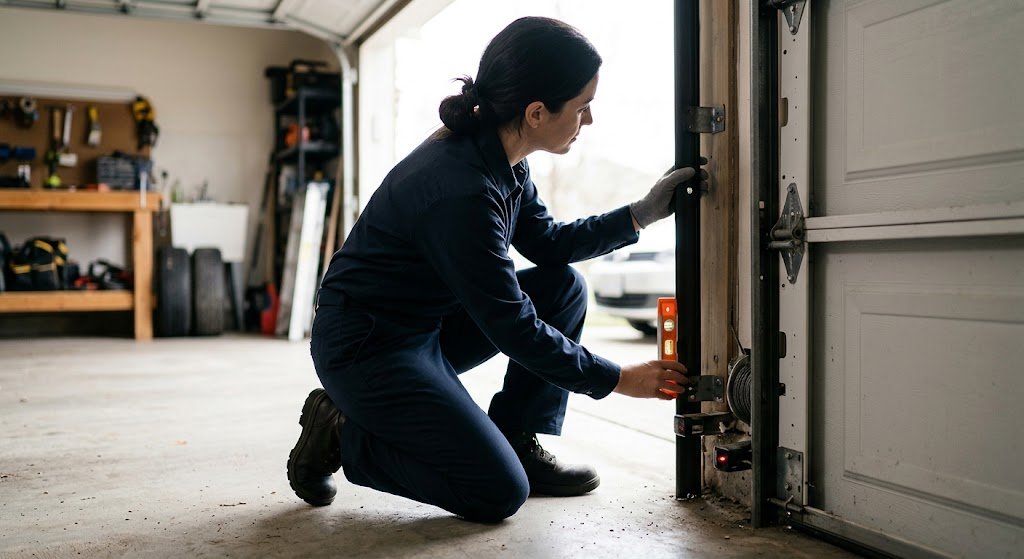
A garage door is the heaviest moving object in a house. It weighs between 130 and 400 pounds, it is powered, it operates several times a day, and children and pets walk under it routinely.
It is also the household system with the least maintenance attention per pound of moving mass. Here is what a proper annual inspection covers, why each item is on the list, and which parts you can check yourself between visits.
The Two Safety Systems That Must Work
Every opener sold in the United States since 1993 is required to have two independent forms of entrapment protection, and both need to be verified.
The photo eyes are the two sensors mounted within six inches of the floor on either side of the opening, projecting a beam across the doorway. If anything breaks that beam while the door is closing, it must reverse immediately without contact. Test it by waving an object through the beam mid-close.
Common faults are misalignment, dirty lenses, damaged wiring, and, worryingly often, deliberate bypassing by a previous owner who found them inconvenient. Sensors mounted higher than six inches are also a fault, because the whole point is to catch a child crawling.
Force reversal is the second system. The door must reverse when it meets resistance. Test it by placing a flat block of wood or a roll of paper towel under the middle of the door and closing it. The door should contact the obstruction and reverse promptly, not press down, hesitate, or continue.
Force settings drift over time, and a door whose force has been turned up to compensate for a mechanical problem has effectively had this protection disabled.
Balance, and Why It Governs Everything Else
The single most informative check on the list.
The opener does not lift the door. The springs do. The opener only guides a counterbalanced door along its tracks. So the balance test tells you the condition of the counterbalance system without touching anything dangerous.
Close the door, pull the manual release, and lift by hand. A correctly balanced door feels heavy but manageable, moves smoothly, and stays roughly where you leave it at waist height. A door that sinks, slams down, or shoots upward is unbalanced.
An unbalanced door is not just a future spring failure. It is currently destroying the opener, wearing the cables unevenly, and running with a compromised safety margin.
The Counterbalance Components
These are inspected visually and never handled by a homeowner, because springs and cables hold enormous stored energy even with the door closed.
Springs are checked for surface rust, for any visible gap in the coil indicating a break, and for remaining cycle life. Springs are rated in cycles rather than years, roughly 10,000 for a standard pair, which is about seven years of average household use. A technician can estimate remaining life from the door age and household usage.
Cables are checked end to end for broken strands standing away from the cable, for corrosion at the lower end where water and salt collect, and for even tension on both sides.
Drums are checked for correct positioning on the shaft and for cable seating, and the bearings and shaft for play and wear.
The Running Gear
Rollers are checked for free rotation, bearing play, and wear on the stems. A roller that has stopped rotating drags in the track, wears it, loads the springs, and eventually leads to an off-track failure.
Hinges are checked for cracking and for elongated fixing holes, which indicate the door has been flexing.
Tracks are checked for straightness, for correct clearance from the door edge, and for secure brackets into the jamb. Loose track brackets are consequential because they carry the entire door load into the structure.
And the sections themselves are checked for damage, delamination, rust perforation, and bowing.
The Opener
Travel limits, so the door stops in the right place at both ends. Force settings, checked against the auto-reverse rather than adjusted to overcome a mechanical fault. The drive system, chain, belt or screw, for tension and wear. The manual release, confirmed to work. And the electrical connections and mounting, which vibrate loose over time.
On older units the inspection also covers whether the opener predates the 1993 safety standard, which is a replacement recommendation regardless of how well it appears to run.
What You Can Do Between Visits
Twice a year, fifteen minutes: lubricate rollers, hinges, bearings and springs with a proper garage door lubricant, tighten the visible hardware, test the auto-reverse with a block of wood, break the sensor beam to confirm it reverses, check the balance by hand, look at the cables for fraying without touching them, and check the bottom seal for daylight with the door closed.
That covers most of the ground. What it cannot cover is remaining spring cycle life, drum and shaft condition, and anything requiring tension to be released, which is why an annual professional garage door safety inspection is the sensible complement rather than a substitute for either.
One Related Check
If the garage is attached, the door between the garage and the living space is a fire separation. It should be solid core or fire rated and it should be self-closing. A great many households disable the self-closer because it is annoying, which defeats the purpose entirely.
It takes two seconds to check and it is worth doing at the same time as everything else.