
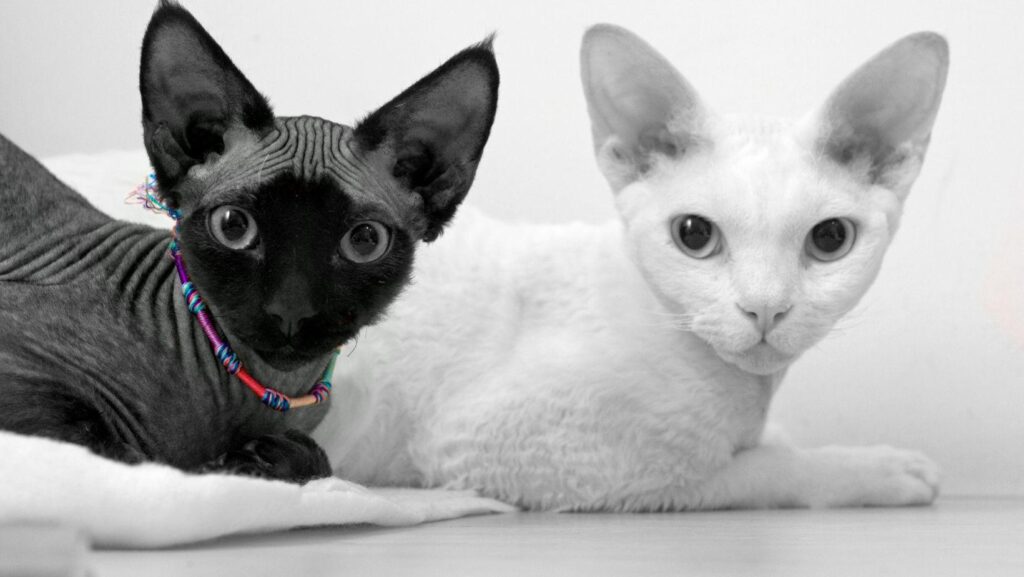
According to the Cat Fanciers’ Association’s Most Popular Breeds Report, 2025, the Devon Rex ranked 5th among all registered pedigree breeds in the U.S., described officially as possessing “a mischievous and affectionate nature” that makes it a delightful choice for families who want a playful, interactive companion.
The Sphynx, recognized by the CFA in 1985, ranks close behind, celebrated for “extroverted behavior, high energy levels, and affection towards their families.” These are the two most visually distinctive breeds in the pedigree cat market, frequently confused by prospective buyers, and genuinely different in the ways that determine whether the ownership experience is the right fit.
Devon Rex vs Sphynx is not a question of which breed is more unusual. Both are exceptional. It is a question of which breed’s specific coat type, temperament expression, grooming demands, and health considerations align with your household.
A Devon Rex Cat carries a short, soft, wavy coat that covers its body in fine curls, giving it a pixie-like warmth in texture that the Sphynx does not replicate. Its large ears, oversized eyes, and angular elfin face are visually arresting, and its personality matches the appearance: mischievous, acrobatic, and consistently entertaining. A Sphynx Cat is not entirely hairless but carries only a fine peach-fuzz on its bare skin, making it the more visually dramatic of the two and the one requiring more active daily maintenance. Its personality is equally compelling: deeply affectionate, physically warm to the touch, and oriented toward its people with an intensity that most coated breeds do not match.
What Is the Difference Between Devon Rex and Sphynx Cats?
Physical Appearance
The most immediate difference between Devon Rex and Sphynx cats is the coat, and that difference is significant in both feel and care implications.
The Devon Rex’s wavy, soft coat covers most of its body, though it can be thin in areas and some individuals experience partial coat thinning as they age. Colors and patterns display through the fur in the same way as any coated breed. The Sphynx’s skin pigmentation mirrors what the coat pattern would be, so colors and markings are visible directly on the skin surface. Both breeds have the large bat-like ears and prominent cheekbones that give them their distinctive profiles.
Body structure is similar: both are medium-sized, fine-boned, and muscular with a lightweight, athletic build. The Devon Rex typically weighs 6 to 9 pounds; the Sphynx typically 6 to 12 pounds.
Temperament and Social Needs
Both breeds are high-energy, people-oriented, and unsuited to households where long daily solitude is unavoidable. The difference between Devon Rex and Sphynx in temperament is one of expression rather than intensity.
Devon Rex Cats are energetic and theatrical. They clown around, seek high perches, hide and call their owners to find them, and thrive on active play. Their vocalization is present but moderate. They bond broadly across the household rather than fixating on one person.
Sphynx Cats are physically demonstrative in a way the Devon Rex is not. They burrow under covers, press against their owners for warmth, and seek body contact as a primary mode of interaction. Their social dependency is measurably higher than the Devon Rex’s, and extended daily solitude produces anxiety-driven behavior more reliably in Sphynx Cats than in Devon Rex Cats.
Devon Rex Cat Care
The Devon Rex’s wavy coat requires only occasional gentle brushing, making it one of the most coat-low-maintenance breeds available. The primary care considerations are:
- Ear cleaning every two weeks: the large ears accumulate wax faster than average
- Nail trimming every two weeks
- Dental care: annual professional cleanings and home brushing
- Temperature management: the thin coat provides minimal insulation; Devon Rex Cats seek warmth consistently and appreciate warm bedding and indoor temperatures above 68 degrees Fahrenheit
Sphynx Cat Care
The Sphynx Cat’s care routine is more intensive and more specific. Without fur to absorb the skin’s natural oil secretions, daily and weekly maintenance is required to prevent bacterial and fungal skin issues.
The standard Sphynx Cat care protocol:
- Daily wiping of skin folds (neck, underarms, tail base) with a soft damp cloth or unscented pet wipe to prevent oil buildup between baths
- Weekly bathing with a gentle, cat-formulated shampoo, followed by thorough drying to prevent cold and bacterial skin conditions
- Weekly ear cleaning to remove the wax that accumulates rapidly without fur lining the ear canals
- Nail trimming every two weeks and eye discharge wiping daily
How Do Devon Rex and Sphynx Cats Compare Across Key Factors?
|
Feature |
Devon Rex Cat |
Sphynx Cat |
|
Coat |
Short, wavy, soft fur |
Near-hairless, fine peach-fuzz only |
|
Grooming |
Occasional gentle brushing |
Weekly bathing required |
|
Body weight |
6-9 lbs |
6-12 lbs |
|
Lifespan |
12-16 years |
12-16 years |
|
Energy level |
Very High |
Very High |
|
Solitude tolerance |
Low-Moderate |
Low |
|
Primary health concerns |
HCM, patellar luxation |
HCM, skin infections, temperature sensitivity |
|
Daily skin/coat care |
Minimal |
Daily fold wiping, weekly bathing |
|
CFA recognition |
Yes |
Yes (1985) |
|
Best for |
Active owners, families |
Devoted owners, low-solitude households |
What Health Considerations Apply to Each Breed?
Both breeds share a predisposition to hypertrophic cardiomyopathy (HCM), the most common cardiac disease in cats. Annual cardiac auscultation from age 3 and echocardiogram screening from age 5 are the recommended monitoring protocols for both. Responsible breeders of either breed screen their breeding cats by echocardiogram rather than relying on genetic testing alone.
Devon Rex Cats additionally carry risk of patellar luxation (kneecap displacement) and a breed-specific muscular condition called Devon Rex myopathy, which causes progressive muscle weakness. Both conditions are manageable with veterinary oversight.
Sphynx Cats carry an elevated risk of skin infections and fungal conditions when grooming is inconsistent, and are significantly more vulnerable to temperature extremes than coated breeds. Sun exposure is a genuine concern for Sphynx Cats whose bare skin burns in direct sunlight.
Choosing Between Two Exceptional Breeds
Sphynx cat vs Devon Rex is a lifestyle decision. Both breeds deliver extraordinary companionship. The Devon Rex delivers it through playful, theatrical energy and a low-maintenance wavy coat. The Sphynx Cat delivers it through physical warmth, intense devotion, and a care routine that is more demanding but produces one of the most tangibly close cat-human relationships available.
Choose the Devon Rex Cat if: the coat distinction matters to you, you want active mischief and acrobatic entertainment, and your household includes children or other active pets.
Choose the Sphynx Cat if: physical closeness is your primary priority, you are home consistently and can provide the body warmth and daily maintenance this breed genuinely requires, and you want a cat whose affection is felt rather than observed.
Frequently Asked Questions
What is the main difference between Devon Rex and Sphynx cats?
The primary difference is the coat. The Devon Rex has a short, soft, wavy fur coat that covers its body, requiring minimal active grooming. The Sphynx has near-hairless skin with only a fine peach-fuzz, requiring weekly bathing and daily skin fold wiping to prevent oil buildup and bacterial skin conditions. Both breeds share high energy, strong social orientation, and a similar temperament profile.
Which is easier to care for: a Devon Rex Cat or a Sphynx Cat?
The Devon Rex Cat is significantly easier to maintain on a daily basis. Its coat requires occasional gentle brushing and ear cleaning rather than the Sphynx Cat’s weekly bathing protocol and daily skin maintenance. For owners who want a distinctive, low-coat-maintenance companion, the Devon Rex Cat is the more practical choice.
Are Devon Rex or Sphynx cats better for families with children?
Both breeds are family-compatible, but the Devon Rex Cat’s theatrical, active play style suits children who engage energetically, while the Sphynx Cat’s physical closeness and body-warmth-seeking behavior suit families who want a physically cuddly companion. Both require that children handle them gently, and neither tolerates rough play that risks injury to their fine-boned frames.
Do Devon Rex or Sphynx cats have more health problems?
Both breeds share HCM as a primary concern. The Devon Rex Cat additionally carries breed-specific risks of patellar luxation and Devon Rex myopathy. The Sphynx Cat carries higher risks of skin infections from insufficient grooming and temperature-related health issues. Neither breed is broadly unhealthier than the other. Sourcing from a breeder who conducts echocardiogram screening is the most impactful health decision for either breed.
How long do Devon Rex and Sphynx cats live?
Both breeds have a documented lifespan of 12 to 16 years with appropriate care. The most significant longevity factors for both are consistent cardiac monitoring from age 3 onward, maintaining a healthy body weight, and proactive veterinary care that catches breed-specific conditions at their earliest and most manageable presentation.