
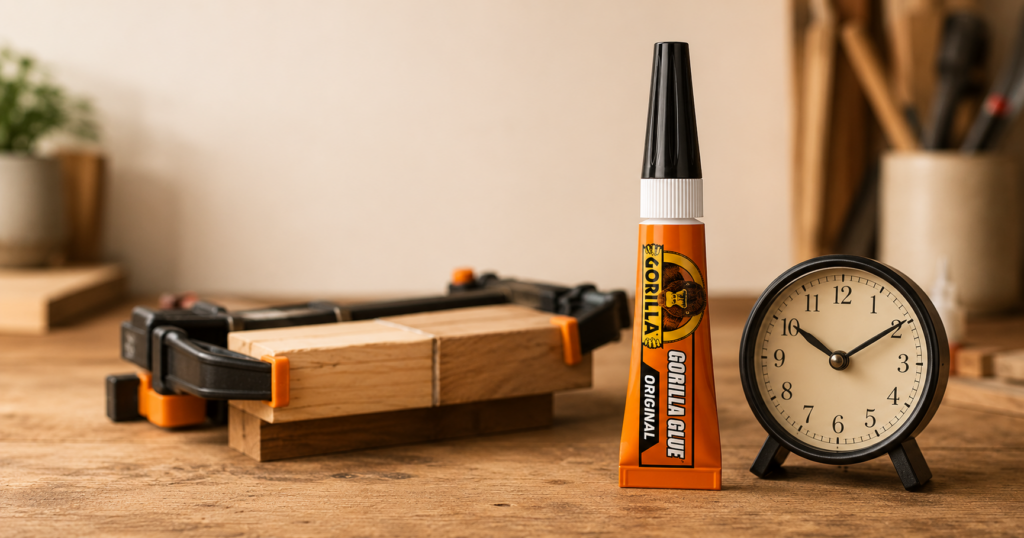
You glue two pieces together, wait an hour, touch it, and it feels solid. So you pick it up, put weight on it, or head straight back to the rest of the project. Then, a day or two later, the joint fails anyway, even though it felt completely dry. This trips up more people than almost any other part of gluing, and it comes down to one distinction that product labels mention but rarely explain properly: dry time and cure time are not the same thing, and mixing them up is probably the single biggest reason DIY glue-ups fail. Understanding the difference, across whatever's in Gorilla Glue's range of adhesives, is the fastest way to stop redoing the same repair twice.
What "Dry" Actually Means
Dry time is simply how long it takes for a glue to stop feeling wet or tacky to the touch. For water or solvent-based adhesives, that's the point where enough moisture has evaporated that the surface feels set. For something like super glue, dry time can be as short as a few seconds, which is exactly why people assume the job is done almost instantly. The problem is that "dry" only describes the surface. It says nothing about whether the bond underneath has actually finished forming, and in most cases, at the dry stage, it hasn't.
What "Cure" Actually Means
Cure time is how long it takes for the adhesive to complete its full chemical reaction and reach maximum strength. With something like epoxy, that means the two components finishing their crosslinking reaction all the way through, not just on the surface. With cyanoacrylate super glue, it means the reaction with moisture in the air continuing well after the visible tack disappears. Cure often takes vastly longer than dry, sometimes twenty, thirty, or more times longer, and it's the number that actually determines whether a joint will hold under real load, not just look finished.
A Quick Way to Think About It
It helps to picture concrete rather than glue for a second. Fresh concrete can feel firm enough to walk on within a day, but it keeps gaining strength for weeks afterward, and nobody would drive a truck over it just because the surface felt solid underfoot. Adhesives work on the same basic principle, just compressed into hours instead of weeks. The surface locking up quickly is a feature, since it stops things shifting around while the real work happens underneath, but it was never meant to be read as "finished."
Why the Gap Between Them Matters
This is where most failures happen. A joint can look and feel completely dry within minutes while still being a fraction of its final strength underneath. Load it too early, by picking it up, clamping something else onto it, or putting it under any stress, and you can shift the bond before it's ever had the chance to reach full strength. It won't necessarily fail immediately either. Sometimes it holds for days or weeks before finally letting go, which makes it even harder to trace the failure back to impatience rather than a bad glue.
How the Numbers Actually Compare
Super glue is the most deceptive of the lot, since it can dry to the touch in ten or fifteen seconds while still needing a full day to reach its final strength. Epoxy is a bit more honest about it, typically listing both a working time, how long you have to position things before it starts to grab, and a full cure time that can stretch anywhere from a few hours for a fast formula to twenty-four hours or more for a stronger, slower one. Wood glue sits in between, usually needing twenty to thirty minutes of clamping before the joint can hold its own shape, but a full twenty-four hours before it's ready for real stress or weight. Construction adhesives and gap-filling formulas tend to be the slowest of all, since a thicker bead simply takes longer to cure all the way through than a thin one does.
How to Know How Long to Actually Wait
Check the label for both figures, since most reputable adhesives list dry time and full cure time separately, even if the difference isn't always obvious at a glance. As a rough guide, light handling is usually fine once the dry time has passed, but anything structural, anything load-bearing, or anything that needs to survive being knocked around should wait for the full cure time before it's tested at all. When in doubt, waiting longer costs you nothing but a bit of patience. Rushing it can cost you the whole repair.
The Short Version
Dry time tells you when a joint stops feeling wet. Cure time tells you when it's actually strong. Treating the first number as if it were the second is how a perfectly good glue ends up blamed for a failure that was really just bad timing. Give a bond the time it actually needs, and most of the "this glue doesn't work" complaints disappear on their own.
If there's one habit worth building, it's reading the label before the tube goes back in the drawer rather than after the joint has already failed. A minute spent checking both figures tells you whether you're dealing with a job you can finish this afternoon or one that needs to sit untouched overnight. Either way, you'll know exactly what you're waiting for, instead of guessing and hoping the glue was doing more than it actually was.