
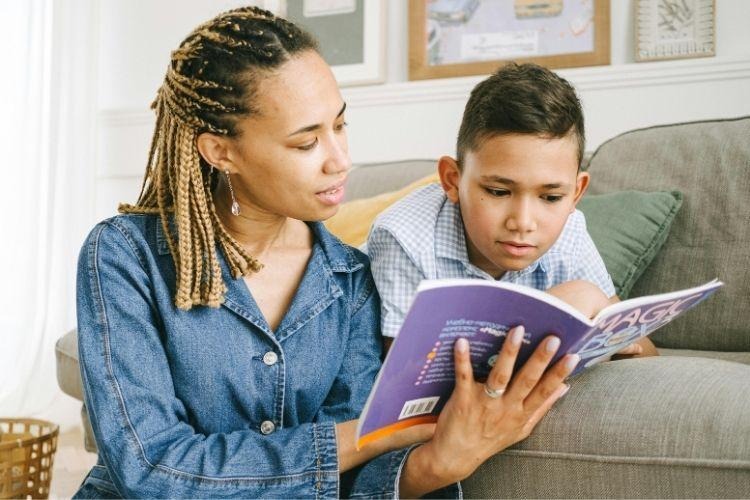
A good children’s book can do more than fill twenty quiet minutes before bed. It can give a child a safe place to test an idea, question a decision, and imagine the consequences of a different choice.
This matters during the primary-school years, when children start to notice how families, communities, and the wider world work. They ask why one person has more than another, why adults must pay for things, and why a rule that seems fair to one person can feel unfair to somebody else.
Parents don’t need to turn reading time into a formal lesson. A few well-chosen questions can help children think about motives, trade-offs, and values. The aim isn’t to supply the “correct” opinion, but to help them explain their thinking, listen to another view, and reconsider when the evidence points elsewhere.
Choose Books That Leave Room for Questions
Books that support thoughtful conversations don’t all need to look educational. Adventure stories, family dramas, mysteries, biographies, and funny school stories can raise questions about courage, honesty, work, money, and justice.
A varied reading diet helps. One story might show a character saving for something important. Another could centre on unfair competition or a difficult choice between helping a friend and following a rule. Families seeking story-led books about markets, law, and personal responsibility can visit Tuttle Twins. Historical fiction, traditional tales, library recommendations, and books written from unfamiliar viewpoints can widen the conversation further.
No single book should have the final word on a complicated subject. A strong home bookshelf gives children ideas to compare, not conclusions to repeat.
Move Beyond “What Happened?”
Asking a child to summarise a chapter can check whether they followed it, but the best conversations usually begin afterwards. The Education Endowment Foundation lists predicting, questioning, making inferences, connecting ideas, and drawing conclusions among the strategies that support reading comprehension. Its evidence review also recommends texts offering “an effective, but not overwhelming, challenge”.
Try questions with more than one defensible answer:
- Why do you think the character made that choice?
- Who benefited, and who lost out?
- What might have happened if they had chosen differently?
- Was the rule fair in every situation?
- What information would you want before deciding?
A child may answer with one sentence or talk for ten minutes. Follow their interest rather than working through a checklist.
Make Money Part of Ordinary Family Talk
Money can feel like an adult subject, especially when household finances are tight. Yet children encounter it constantly through card payments, ads, online purchases, and conversations about what the family can afford.
MoneyHelper says money skills begin developing between ages three and seven, with habits starting to form by seven. It recommends small steps and real-life experiences, including discussions about wants, needs, saving, and spending choices. It also offers a reassuring reminder: “You don’t have to manage your own money perfectly” to teach children useful habits.
Stories make these conversations less personal. Instead of asking a child to defend how they spent their pocket money, discuss a character’s choice. Did buying the cheaper option solve the problem? Was borrowing sensible? What did the character give up by spending now rather than saving?
The Bank of England uses a similar approach in its free Money and Me resources for primary schools. Its 12 lessons cover payment methods, budgeting, debt, scams, and ethical spending through situations that pupils can discuss.
Keep the language concrete. Younger children understand “You have £5 and two things cost £4 each” more easily than an abstract explanation of scarcity. Older children can consider advertising pressure and the difference between price and value.
Talk About Fairness Without Assuming It Means Sameness
“It’s not fair” can mean “I got less”, “the rule changed”, “someone had an advantage,” or simply “I dislike the outcome.”
Research suggests that children’s understanding of fairness starts early but isn’t limited to equal shares. A review in Trends in Cognitive Sciences argues that a sense of fairness can appear from around age three in collaborative situations. Other research involving children aged three to eight found that they considered procedures, outcomes, and the recipients’ emotions when judging unequal distributions.
Books offer simple ways to examine these differences. Suppose three characters share a reward. Should each receive the same amount? Should the person who did the most work receive more? What if one person couldn’t contribute because they were ill? What if everyone agreed on the rules beforehand?
There is no need to rush towards a neat answer. The useful part is hearing a child identify the principle behind their choice. They may favor equality in one situation and need or effort in another. That may show they are learning to consider context.
Keep the Conversation Curious, Not Corrective
Children quickly notice when an apparent discussion is really a test. If every answer receives an immediate correction, they may start guessing what the adult wants to hear.
Begin with curiosity. Ask, “What makes you say that?” Then reflect the answer: “So you think the decision was fair because everyone knew the rule?” This shows that you are listening and gives the child a chance to refine the idea.
Parents can share their views, but let the child finish first. Try, “I saw it differently because…” rather than announcing the lesson. When a book presents a strong opinion, ask what evidence supports it, what might challenge it, and whose voice is missing.
This permits children to disagree respectfully. It also teaches them that changing an opinion isn’t losing an argument. It is a reasonable response to better evidence.
Connect the Page to Everyday Life
A conversation becomes more memorable when children can link it to something familiar. After reading about saving, compare prices during the weekly shop. After a story about a business, discuss why a café charges more than the cost of its ingredients. A book about fairness might lead to a conversation about taking turns, team selection, or different rules for siblings of different ages.
Keep these activities low stakes. A child who spends a small allowance and later regrets it has learned something without facing a serious consequence. A child who helps plan a modest family treat can see that choosing one thing often means postponing another.
The goal isn’t to make every outing educational. It is to notice when a story has already opened the door.
Conclusion
Reading beyond the story doesn’t require specialist knowledge or a perfectly planned discussion. It requires time, attention, and a willingness to take a child’s questions seriously.
Books can help families talk about life before children must face every situation themselves. They can make money less mysterious, show that fairness has several meanings, and give children practice in explaining a view without dismissing somebody else’s.
The next time a chapter ends, pause before closing the book. Ask one genuine question and see where it leads. The conversation may be brief, surprising, or unresolved. That is often where the most useful thinking begins.