
How to Test a DIY Idea Before Committing Time and Money begins with a tight, falsifiable question: will real people pay, use, or care about the solution? This short playbook shows readers how to turn intuition into fast, low-cost tests that protect time, wallet, and reputation. It focuses on five concrete steps: define the idea, talk to people, run cheap experiments, track simple metrics, and set clear go/no‑go rules. The approach fits hobby projects, home fixes, and small product bets.
Key Takeaways
- Test a DIY idea by clearly defining the problem, solution, risks, and success criteria to avoid wasted resources.
- Engage 5–15 real users early with interviews to validate needs without pitching, tracking willingness to pay as a key metric.
- Run low-cost experiments like landing pages or small pilots to quickly test core assumptions and customer interest.
- Use simple, measurable metrics such as signups and deposits to guide decisions and set clear go/pivot/kill thresholds.
- Calculate realistic costs and time commitments upfront, including labor buffers, to prevent sunk-cost fallacies.
- Commit to a DIY idea only when tests meet go criteria; pivot if partial interest exists, or shelve if demand is insufficient.
Define The Idea, Risk Tolerance, And Success Criteria
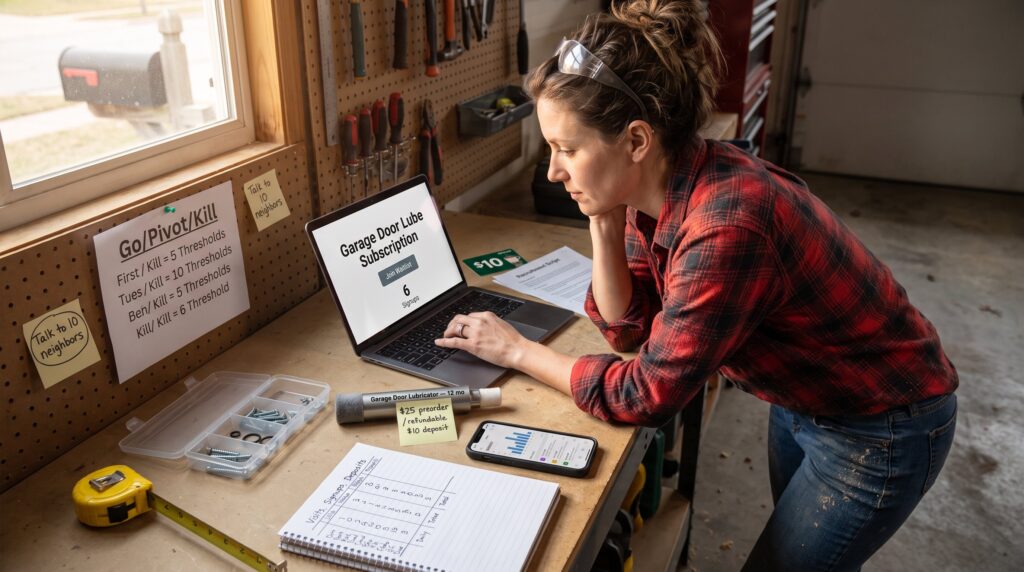
State the fact first: a clear idea with defined risks and success metrics reduces wasted effort. Write a one-sentence problem and one-sentence solution. For example: “Problem: the garage door squeaks nightly: Solution: a DIY lubricator kit that lasts 12 months.” List three core assumptions: target user, frequency of the problem, and why this fix is better than current workarounds.
Next, set risk tolerance. Specify maximum money, hours, and reputation exposure. A practical cap might be $150 and 12 hours for a small home project: for a product prototype it could be $1,200 and 40 hours. Make these concrete numbers and stick to them.
Finally, define success criteria that map to action. Good examples: 25 email signups in two weeks, five paid preorders, or a 30% reply rate from interviews. These targets convert vague hopes into testable thresholds. If a homeowner wants broader context on practical ideas and project priorities, consult the practical ideas guide for related examples and project framing.
Talk To Real People: Quick Interviews And Customer Discovery
Answer first: talk to actual users early, not later. Schedule 5–15 short interviews with people who match your narrow target. Use past-focused questions: “How did you solve this last month?” and “How much did you spend?” Avoid pitching during discovery.
Concrete tip: recruit interviewees from local groups, neighborhood boards, or social posts. Offer a $10 coffee card for 20 minutes. A typical successful run yields 8 interviews in one weekend and surfaces repeatable pain points, e.g., 6 of 8 said they tolerate the squeak because fixes are ‘too fiddly.’
Record each session and log frequency, costs, and workarounds in a simple spreadsheet. Track a single column: “Would pay >$10?” Mark yes/no. If fewer than 2 of 10 say yes, the idea needs rethinking. Use this stage to surface non-obvious constraints: safety concerns, tool gaps, or seasonal demand spikes.
For readers focused on home tasks, see the article about organize household tasks for simple recruitment channels and follow-up tactics.
Run Low‑Cost Experiments To Validate Core Assumptions
Direct answer: run experiments that cost little and answer the riskiest questions first. Turn assumptions into hypotheses like “10% of visitors will join a waitlist” or “20% of interviewees will preorder at $25.”
Common low-cost tests:
- Landing page with a signup form (smoke test)
- Fake door: advertise a product that isn’t built yet
- Concierge MVP: deliver the service manually to first customers
- Small pilot: produce 10 units and sell them locally
A practical example: someone made a one-page landing page and spent $30 on local Facebook ads. In 10 days they got 32 visitors and 6 signups, an 18% signup rate that validated interest. If the signup cost is below your risk tolerance, move to a paid-test.
Test willingness to pay directly: offer a $10 refundable deposit or early-bird preorders. Track conversion and refund rates: a 60–70% completion after deposit is a strong signal.
Design Simple Metrics, Track Results, And Decide What To Do Next
Start with measurable, minimal metrics: visits, signups, deposit conversions, and reply rate. Run each test for a fixed window (e.g., two weeks) and log daily totals. Use plain thresholds: if conversion < X, pivot assumptions: if conversion ≥ X, scale one step. Keep records in a single sheet and summarize learnings in two sentences per test.
Estimate Costs, Time, And Clear Go/No‑Go Criteria
Fact first: a realistic bottom-line estimate prevents sunk-cost escalation. Break costs into categories: materials, tools, outsourcing, and ongoing support. Example: a DIY kit may require $40 in parts, $20 for packaging, and 2 hours assembly per unit. Multiply by your initial batch size to get an upfront spend.
Estimate time the same way: prototype build time, per-unit assembly, and customer support. If assembly is two hours per unit, 50 orders equal 100 hours, decide if that fits your capacity.
Define three thresholds with specific numbers: Go, Pivot, Kill. Example:
- Go: ≥30 paid preorders at $30 with unit cost ≤$20 and delivery within 30 days.
- Pivot: 10–29 preorders or cost slightly higher: test price or channel adjustments.
- Kill: <10 preorders or unit economics loss exceeding risk tolerance.
Include an honest warning: underestimate of labor is the most common error. Many makers forget handling returns or warranty calls: add a 15–25% buffer to labor estimates.
If roofing or structural concerns appear, read the guide about diy roofing risks to avoid costly safety mistakes.
Conclusion: When To Commit, Pivot, Or Shelve Your DIY Idea
Immediate insight: commit only when tests meet your go thresholds and economics work. Commit when the problem is frequent, tests show willingness to pay, and delivery fits your time budget. Pivot when interest exists but key assumptions (price, channel, or feature) fail, run focused follow-up experiments. Shelve when interviews and experiments show low demand or irrecoverable economics.
A prudent next step for curious readers: balance these outcomes with wider project planning and look to related practical tips like small repairs that prevent bigger work, for continued idea generation. For examples of low-cost routines and preventive projects, consult the prevent bigger repairs and low-cost wellness habits pages for complementary strategies.
Final honest note: most DIY ideas fail early. The goal is to fail fast, learn cleanly, and preserve time and money for the few that matter.